A private credit pioneer retains its entrepreneurial approach, even after ascending the summit.

Corporate America is filled with companies that innovated, led their industry, and then became less entrepreneurial to protect their position. Prospect Capital Management is an entrepreneurial firm following a very different arc. Yes, the investment manager with $9.4 billion in assets manages one of the nation’s largest and longest-running publicly traded business development companies (“BDCs”). Prospect has driven success over nearly four decades through creativity and by achieving a long list of “firsts” in the market. But Prospect isn’t about to rest on its reputation and market position.
That much is certain after a recent conversation with Prospect Capital CEO John Francis Barry III and President/COO Grier Eliasek. We are proud of our long history of providing important capital to U.S. middle-market businesses that drive the U.S. economy and domestic employment while delivering to our shareholders consistent returns,” Barry told us recently.
Prospect’s history runs longer than many asset management firms. Founded in 1988 by former senior Merrill Lynch executives, Prospect was the first to launch a levered closed-end high-yield bond fund and a levered bank loan fund, an early entrant into the BDC landscape, and the first BDC to acquire another BDC.
Its principals were also early to sustainable investing, from the first commercial solar generating plant in 1983 to later ethanol and biomass financings. Nearly four decades later, that initiative to be “first” is still driving the firm’s strategy. As an industry, private-credit assets have surged into the trillions globally, with competitors chasing scale, large sponsor-backed loans, direct lending to larger companies, software exposure, and other tighter spread and more commoditized strategies. Prospect is adopting a different strategy focused on delivering stronger alpha.
Prospect Bets that Smaller Companies, Stronger Covenants, and Old-Fashioned Underwriting Will Produce the Best Results
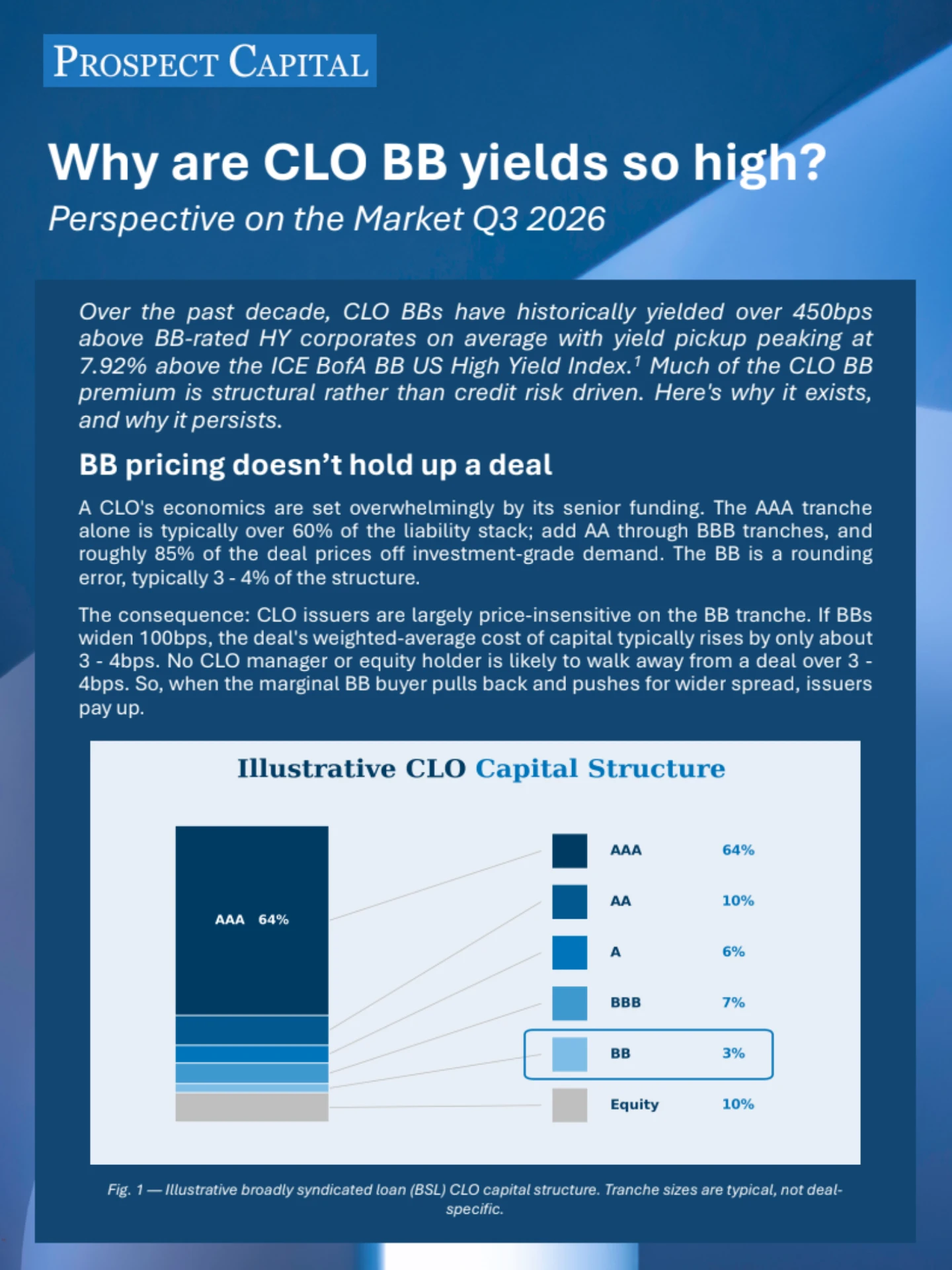
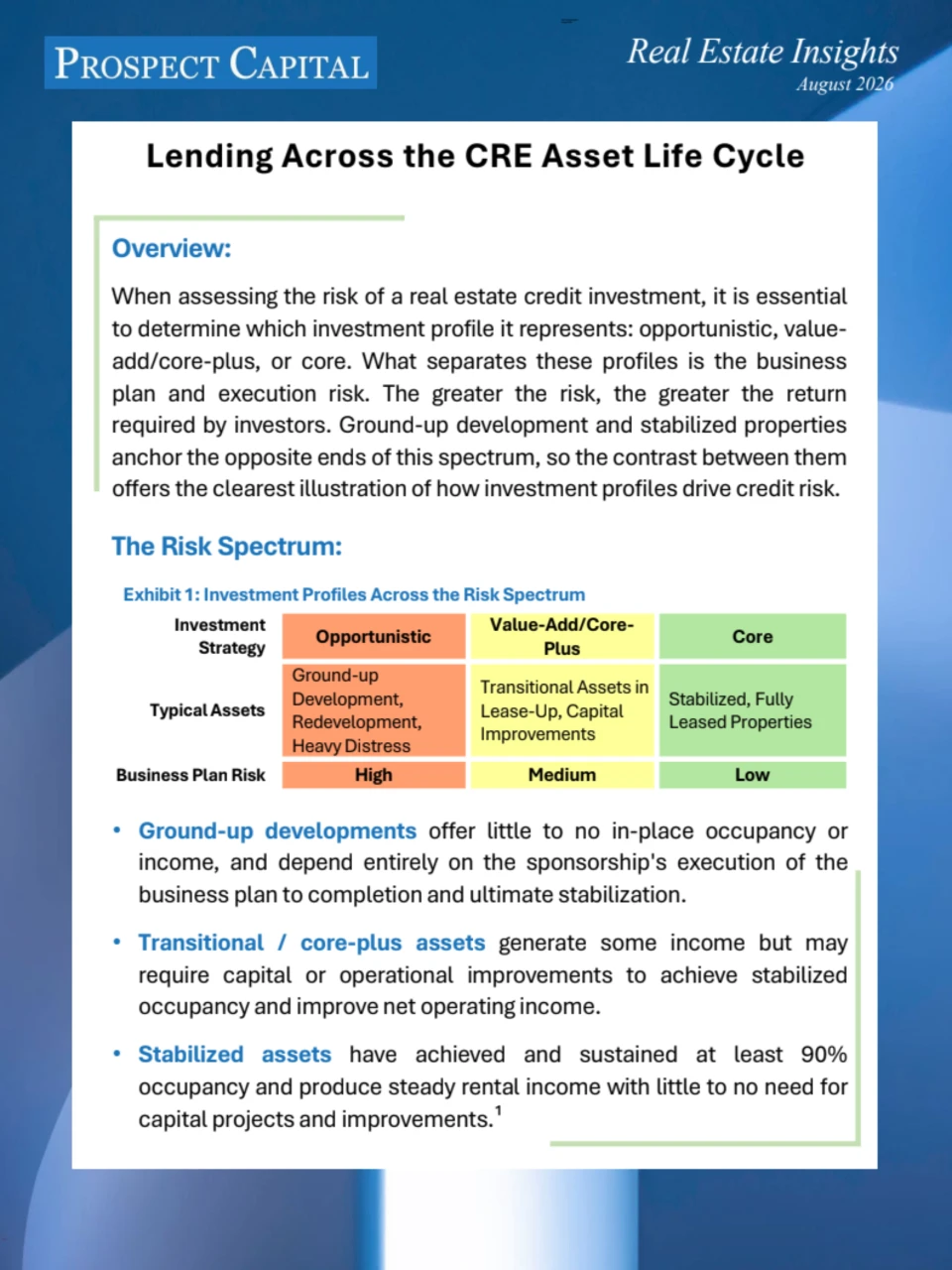
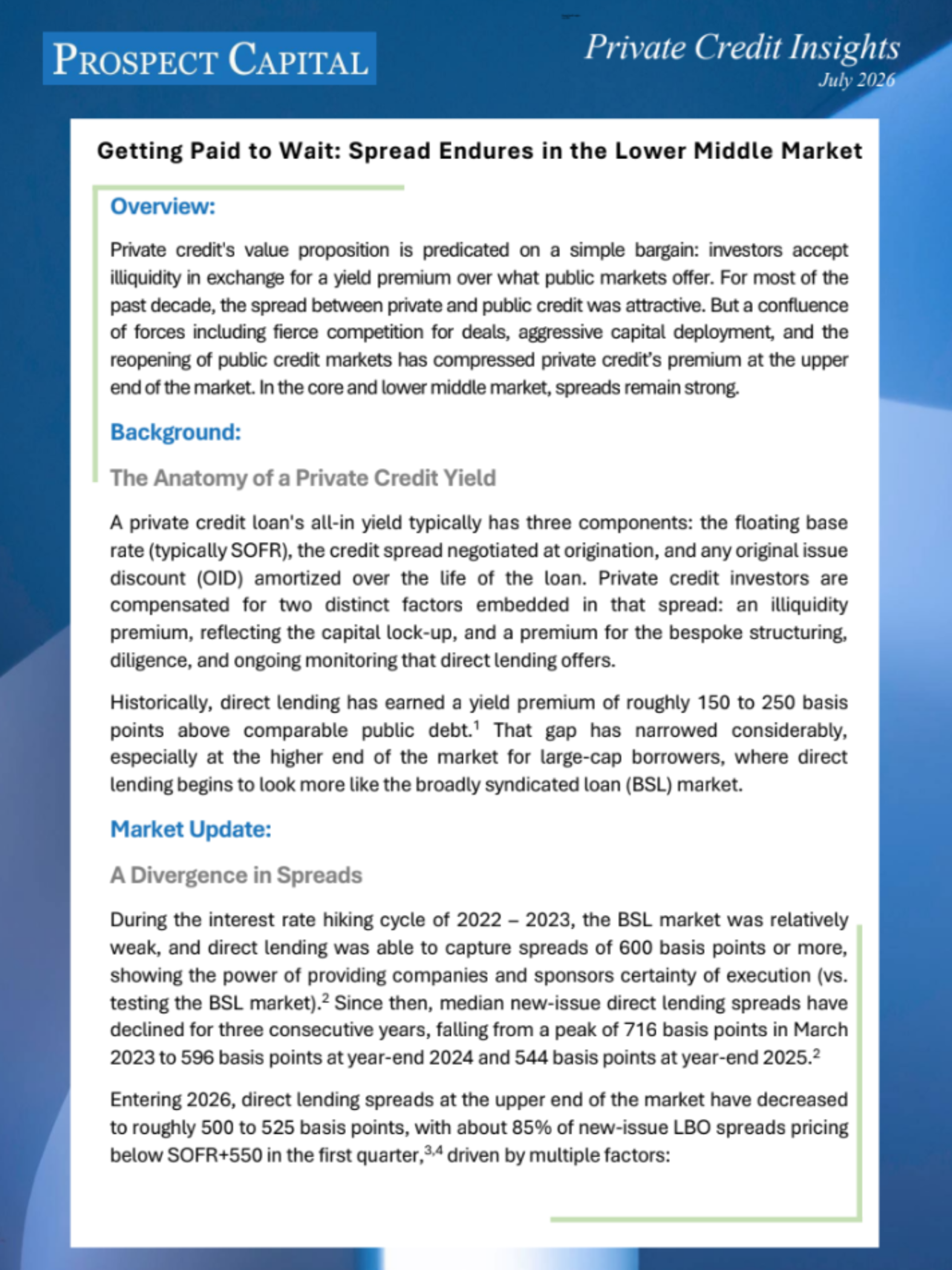
“There are three major opportunities in U.S. private credit,” Eliasek said. “The first is lending to lower-middle-market companies with less than $50 million in annual profit. The second is multifamily real estate mezzanine financing, driven by upcoming mortgage loan maturity walls in that sector. The third is structured credit, particularly CLO debt and similar double-B-rated securities.
“Right now, everyone is crowding around the same ball like in children’s soccer. Most other private credit investors are pursuing a relatively small number of larger companies and private equity sponsors, leaving substantial opportunities elsewhere, namely in the middle market.”
Eliasek elaborated, “there are about 230,000 middle-market companies in the United States earning between $5 million and $150 million annually,” he said. “The vast bulk of the capital raised over the last ten years has been directed toward companies generating more than $50 million in annual profit, which describes only about 10,000 of such companies. That leaves a significant portion of the middle market underserved by loan providers,” Eliasek continued.
“The upper end of the market generally carries more leverage, lower coverage stats, weaker earnings quality, fewer if any financial covenants, and less protective lender documentation. By contrast, lower middle-market transactions tend to include lower leverage, higher coverage stats, smaller EBITDA adjustments, stronger covenants, better documentation, and greater lender protections.
“The reward profile is more attractive as well at the lower end of the market. Spreads and SOFR floors remain higher in the lower middle market, and we often receive equity-linked securities that allow us to participate in the borrower’s upside. Over the last two decades, our lower-middle-market lending business has generated a 17% internal rate of return across hundreds of exits. The lesson is simple: focus your time and capital where others are not doing so.”
An Old-School Approach to Rigorous Underwriting, Covenant Protection, and Strong Documentation
While Prospect takes an arguably contrarian perspective to asset allocation, it continues to take an old-school approach in areas such as underwriting standards, rejecting aggressive addbacks, lack of financial covenants, weak documentation, and lack of lender rights.
“The non-negotiables remain the same,” Eliasek said. “We insist on rigorous underwriting – where we say “no” much more often than “yes”, covenant protection, and strong documentation. Our base cases always assume there will be another economic downturn and underwrite accordingly. We also insist on credit agreement provisions that provide meaningful lender protections in the event of a default.
“Another core principle is being disciplined about addbacks and adjusted earnings. We have a team of CPAs that carefully evaluates profitability to determine what we believe is the true earning power of a business, which typically excludes some of the add-backs that a borrower or sponsor want us to lend against.
“We have also avoided chasing trends. For example, we never embraced revenue-multiple lending in software to the extent many market participants did. We prefer traditional credit underwriting focused on free cash flow and the ability to service obligations.” Prospect generally eschews “the upper end of the market,” according to Eliasek. “It has become highly competitive and commoditized, making it difficult to generate alpha. Transactions are often auction-driven, with numerous lenders competing primarily on higher leverage and lower pricing than we would be comfortable lending.”
“We focus on a different segment of the market and on three primary sources of opportunity: companies owned by smaller private-equity-backed companies, companies owned by independent sponsors, and direct company financings,” he said. “Independent sponsors, for example, are particularly attractive because they often bring significant operating expertise to their businesses and invest meaningful personal capital.”
Eliasek Believes ‘Strong Underwriting Will Drive Performance’
Strong underwriting has become a recipe for success. “Ultimately, strong underwriting drives performance. Our historical non-accrual and realized loss rates, with the latter only averaging around 10 basis points per annum over our multi decade history, have remained below industry averages because we emphasize discipline and risk management.”
At the same time, Prospect will take risks. “This is a needle-in-a-haystack business,” Eliasek said. “Quality comes from reviewing a large quantity of opportunities. We source more than 3,000 opportunities annually and close on less than 0.5% of them.”

WHEN THE NEXT DOWNTURN ARRIVES, I
BELIEVE IT WILL SEPARATE DISCIPLINED
MANAGERS FROM THOSE THAT
RELIED TOO HEAVILY ON LEVERAGE
OR ACCEPTED EXCESSIVE RISK.
— GRIER ELIASEK
“Our expansion into new strategies has generally followed a logical progression. We added CLO investing because it builds on our decades of expertise in senior and secured corporate loans. We expanded into multifamily real estate because the sector offered many of the same attributes that we look for in our loans – customer / tenant diversification, inflation protected returns from short-term tenant leases being similar to floating-rate loan exposure, a value mentality, and attractive risk-adjusted returns.

“Multifamily mezzanine financing is particularly attractive today. As older first mortgage loans mature, many owners are unable to refinance at prior leverage levels, creating a gap that we can help fill.” Still, not every opportunity scales with attractive returns. Prospect previously explored areas such as online lending and aircraft leasing, Eliasek noted, before concluding excessive competition and high operating costs made these sectors less attractive.
When a strategic initiative gains traction, Prospect is keen to develop dedicated offerings. Examples of this include CLO equity, CLO debt, real estate credit, and middle-market lending. “This approach allows investors to allocate capital according to their objectives, target strategies, and risk tolerance while benefiting from our experience in each area.”
Meanwhile, Eliasek keeps one eye on the future, believing “every new investment time horizon will include some form of economic downturn. Our portfolio construction and underwriting reflect that assumption.” “When the next downturn arrives, I believe it will separate disciplined managers from those that relied too heavily on leverage or accepted excessive risk,” he said.
Prospect has been tested on this before. It was the first existing BDC to achieve a credit rating after the 2008 financial crisis, and it has carried ratings for 18 years, currently across four agencies. That “discipline” is what will also separate Prospect from others, according to Barry. “Overall, our strategy is to remain focused on the middle market, maintain conservative leverage, and continue emphasizing proprietary sourcing and underwriting discipline,” Barry said.
“We believe this approach positions us to withstand fluctuating, challenging environments while continuing to generate attractive long-term returns.” In short, Prospect is betting that disciplined underwriting, a conservative lending mentality, prudent leverage, and overlooked market segments, not scale, will prove decisive when the next downturn arrives.

OUR STRATEGY IS TO REMAIN FOCUSED ON THE MIDDLE MARKET, MAINTAIN CONSERVATIVE LEVERAGE, AND CONTINUE EMPHASIZING PROPRIETARY SOURCING AND UNDERWRITING DISCIPLINE.
— JOHN BARRY III