Overview:
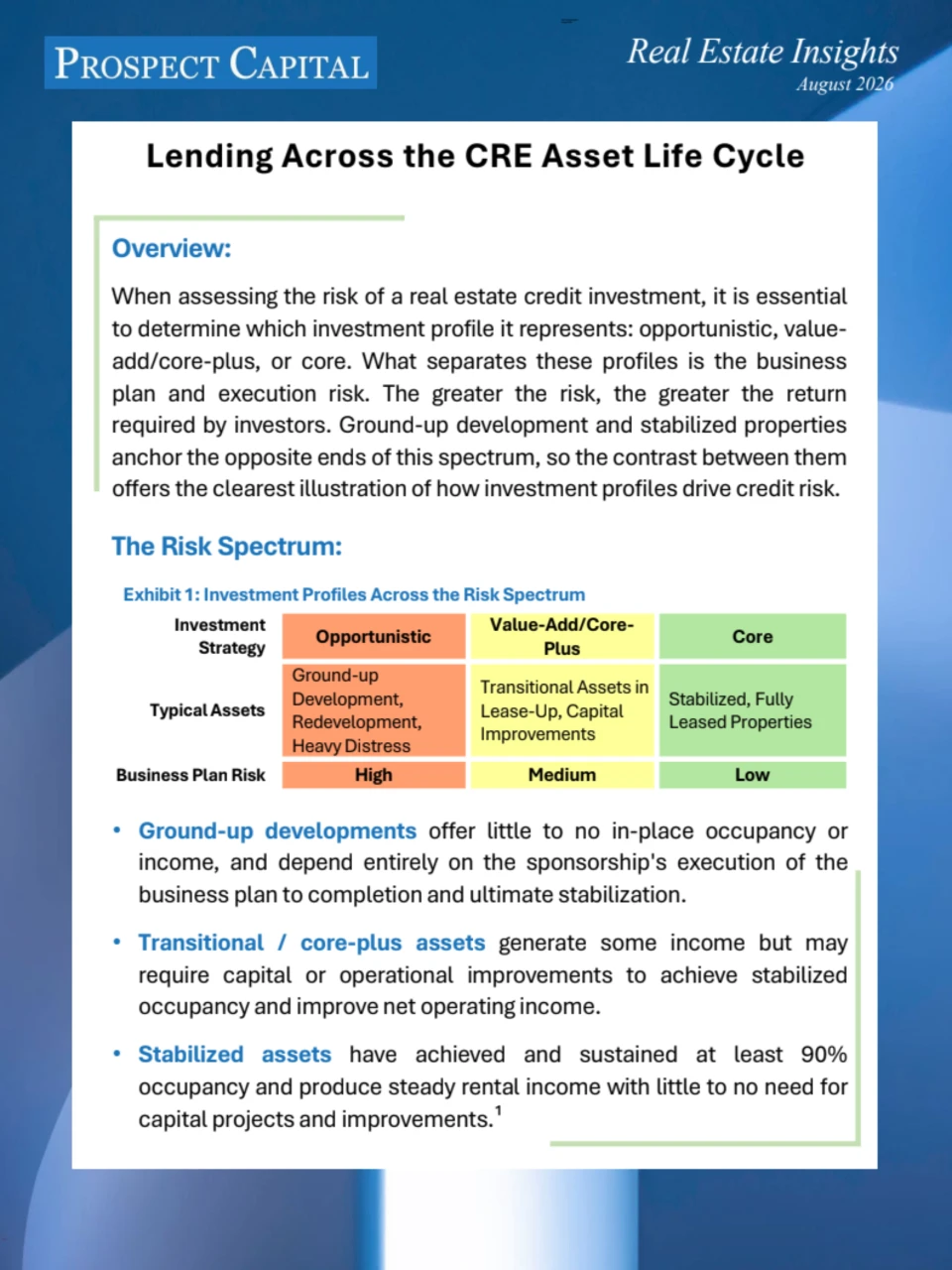
When assessing the risk of a real estate credit investment, it is essential to determine which investment profile it represents: opportunistic, value-add/core-plus, or core. What separates these profiles is the business plan and execution risk. The greater the risk, the greater the return required by investors. Ground-up development and stabilized properties anchor the opposite ends of this spectrum, so the contrast between them offers the clearest illustration of how investment profiles drive credit risk.
The Risk Spectrum:
Exhibit 1: Investment Profiles Across the Risk Spectrum
| Investment Strategy | Opportunistic | Value-Add/Core-Plus | Core |
| Typical Assets | Ground-up Development, Redevelopment, Heavy Distress | Transitional Assets in Lease-Up, Capital Improvements | Stabilized, Fully Leased Properties |
| Business Plan Risk | High | Medium | Low |
• Ground-up developments offer little to no in-place occupancy or income, and depend entirely on the sponsorship’s execution of the business plan to completion and ultimate stabilization.
• Transitional / core-plus assets generate some income but may require capital or operational improvements to achieve stabilized occupancy and improve net operating income.
• Stabilized assets have achieved and sustained at least 90% occupancy and produce steady rental income with little to no need for capital projects and improvements.¹
Why Income Drives Collateral Quality:
Income matters to lenders as it signals a borrower’s ability to make payments and informs a property’s valuation. For a lender, the risk spectrum translates directly into collateral quality. A claim on a development or transitional asset is harder to value, less liquid, and more capital-intensive than a claim on a completed, stabilized property. A
lender on a stabilized, fully leased asset holds claim to a more liquid asset that is easier to value based on in-place, contractual cash flows.
Risk Profile as a Predictor of Loss:
An asset’s risk profile can also be a predictor of losses, as seen during the Great Financial Crisis. In 2008, construction and development loans, the typical collateral behind opportunistic strategies, reached peak non-current rates of 16.6%, compared to 4.4% for stabilized commercial real estate loans.2 Net charge-offs in 2010 told the same story: 6.1% for construction and development loans compared to 1.2% for stabilized commercial real estate, roughly five times higher.²
The gap is attributable to construction and business plan risk on development projects, a point the OCC’s Comptroller’s Handbook echoes when it states that “prudent underwriting includes considering the source and timing of the repayment of construction financing and determining whether the projected net operating income of the completed project supports the expected value upon completion.”³ Principal repayment is demonstrably more at risk when business plan execution and future cash flow assumptions are used to value the underlying collateral.
Regulatory Capital Prices the Same Risk:
Banks price development risk into capital requirements. Bank capital rules assign high-volatility construction and development loans a 150% risk weight, compared to 100% for stabilized loans.⁴ As banks need to hold 50% more capital for every dollar of construction lending, they must earn yields that justify the opportunity cost. However, recent data shows construction loan spreads have compressed to near their lowest levels since 2021,⁵ suggesting that investors are not being fairly compensated for the risk.
The Takeaway for Advisors:
For advisors, the practical takeaway is to look deeper at a fund’s investment profile, target return, underlying collateral and business plan. While real estate credit investors may be insulated by an equity cushion, the level of credit risk varies with the underlying investment profile and amount of leverage applied by the sponsor. As spread compression continues to impact the real estate credit market, investors should demand to be compensated for the incremental risk in transitional and opportunistic strategies. In an environment characterized by significant liquidity in the debt capital markets pursuing fewer quality investment opportunities, investors should be vigilant about
a fund’s underlying risk and return profile to ensure that managers are not drifting from their mandated credit and style boxes.
Sources
1 Brookfield Private Wealth, “Real Estate Stabilization” (glossary), privatewealth.brookfield.com.
2 Federal Deposit Insurance Corporation, Loss Given Default for Commercial Loans at Failed Banks, Center for Financial Research Working Paper 2015-06.
3 Office of the Comptroller of the Currency, Comptroller’s Handbook: Commercial Real Estate Lending (Version 2.0).
4 Federal Register, “Risk-Weighting of High Volatility Commercial Real Estate (HVCRE) Exposures.”
5 Trepp, Anonymized Loan-Level Repository (T-ALLR) construction loan spread data, as reported by CRE Daily, February 2026.
Disclosures
Past performance is not indicative of future results.
Prospect Capital Management L.P. (“Prospect”) is an SEC registered investment adviser that was founded in 1988 (along with its predecessors). Prospect invests across the United States in diversified portfolios by industry, company, and situation, and its proprietary underwriting process and metrics have been developed over more than 30 years and through multiple economic cycles. Prospect has over 150 employees and $9.4 billion** of assets under management as of March 31, 2026. With a buy-and-hold mentality, Prospect’s objectives are to preserve capital by making credit and equity-focused investments at reasonable multiples of recurring cash flow, earn attractive current cash yields and long-term capital appreciation while achieving consistent low-volatility returns. For more information, call 212.448.0702 or visit prospectcap.com.
**The $9.4 billion of Assets Under Management (“AUM”) refers to the assets managed by Prospect and its affiliated registered investment advisors. AUM equals the sum of: (i) the gross assets of (a) Prospect Capital Corporation (“PSEC”), Priority Income Fund, Inc. (“PRIS”), Prospect Floating Rate and Alternative Income Fund, Inc. (“PFLOAT”), Prospect Credit REIT, LLC (“PCRED”), and Prospect Enhanced Yield Fund (“PENF”), and (b) pooled investment vehicles with respect to discrete assets for which Prospect has non-discretionary authority, (ii) any amounts available to be borrowed under certain credit facilities of the investment companies, (iii) total managed assets for real estate and structured credit investments, and (iv) uncalled capital commitments. Prospect’s AUM measure includes assets under management for which Prospect charges either nominal or zero fees. Prospect’s definition of AUM is not based on any definition of assets under management contained in any management agreements of the investment companies Prospect manages. Given the differences in the investment strategies and structures among other investment advisors, Prospect’s calculation of AUM may differ from the calculations employed by other investment managers and, as a result, this measure may not be directly comparable to similar measures presented by other investment managers. Prospect’s calculation also differs from the manner in which Prospect and its affiliates registered with the SEC report “Regulatory Assets Under Management” ($6.9 billion) on Form ADV.
This information is educational in nature and does not constitute an offer to sell or the solicitation of an offer to buy any securities. Prospect is not adopting, making a recommendation for or endorsing any investment strategy or particular security. All opinions are subject to change without notice, and you should always obtain current information and perform due diligence before participating in any investment. All investing is subject to risk, including the possible loss of principal. Prospect cannot guarantee that the information herein is accurate, complete or timely. We make no representation or warranty in respect of any information derived from the third-party sources which has not been independently verified. Prospect and its affiliates do not provide tax, legal or accounting advice. This material is not intended to provide, and should not be relied on for, tax, legal or accounting advice. You should consult your own tax, legal and accounting advisors before engaging in any transaction.