Over the past decade, CLO BBs have historically yielded over 450bps above BB-rated HY corporates on average with yield pickup peaking at 7.92% above the ICE BofA BB US High Yield Index.¹ Much of the CLO BB premium is structural rather than credit risk driven. Here’s why it exists, and why it persists.
BB pricing doesn’t hold up a deal
A CLO’s economics are set overwhelmingly by its senior funding. The AAA tranche alone is typically over 60% of the liability stack; add AA through BBB tranches, and roughly 85% of the deal prices off investment-grade demand. The BB is a rounding error, typically 3 – 4% of the structure.
The consequence: CLO issuers are largely price-insensitive on the BB tranche. If BBs widen 100bps, the deal’s weighted-average cost of capital typically rises by only about 3 – 4bps. No CLO manager or equity holder is likely to walk away from a deal over 3 – 4bps. So, when the marginal BB buyer pulls back and pushes for wider spread, issuers pay up.
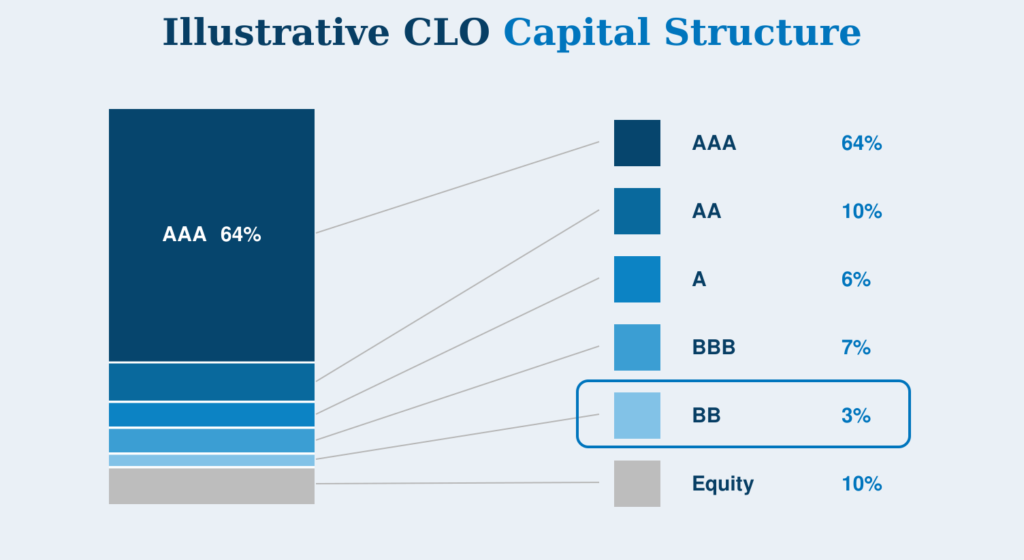
Fig. 1 — Illustrative broadly syndicated loan (BSL) CLO capital structure. Tranche sizes are typical, not deal-specific.
BBs are more correlated than some other fixed income
On the one hand, two BB corporate bonds from different industries are largely different risks. On the other hand, CLO deals often contain many of the same loans, particularly for CLOs issued by the same manager. The overlap risk increases the odds that CLO BB prices will move in tandem.
The mezzanine position amplifies this. A BB tranche typically attaches around 8% collateral losses, a level that is rarely threatened outside of a broad, systemic default wave. However, in such a scenario, many CLO BBs will likely be threatened at once. This high pairwise correlation means less diversification benefit per position, and investors rationally demand extra spread for risk they cannot diversify away.
Three CLOs:
Overlapping collateralization — roughly 30% shared across each pair
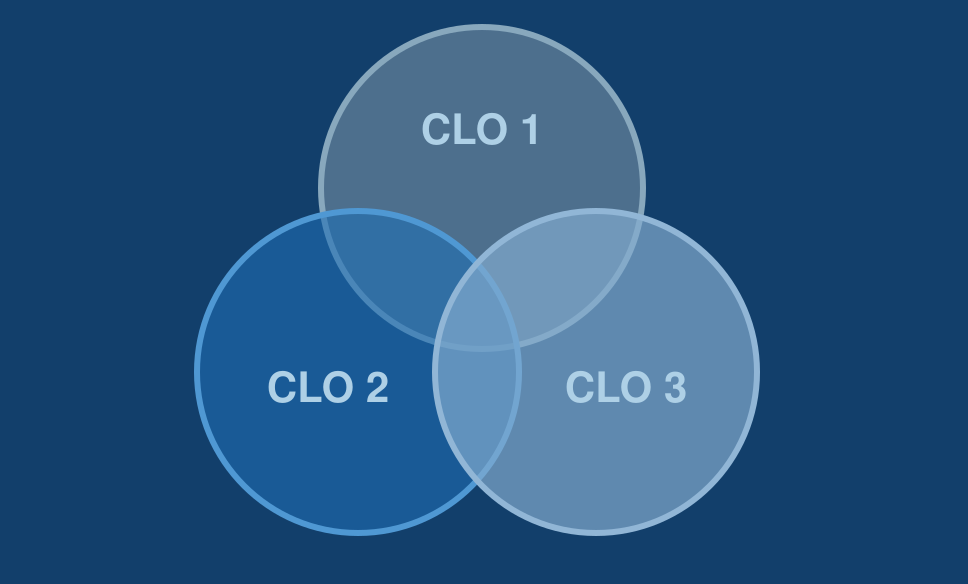
Fig. 2 — Collateral overlap across managers concentrates CLO BB risk on the same systemic factor.
A small, niche market with real barriers to entry
The CLO BB universe is small in absolute terms, a roughly $40 billion market² spread across thousands of individual CUSIPs, each with its own documents, tests, and manager. The buyer base is narrow and almost entirely institutional: specialist credit funds, hedge funds, insurers, and a handful of dedicated vehicles. There is minimal retail participation, no existing ETF pure play, and few large dealer balance sheet standing behind the tranche.
Analysis itself is also costly. Properly underwriting CLO BBs requires specialized expertise and expensive software to model the waterfall, overcollateralization and interest coverage tests, and reinvestment behavior. When the pool of capable buyers is structurally capped, spreads must be wide enough to fully mobilize it: fewer bidders, better prices for those in the room.
Moderate spread duration means real mark-to-market risk
CLO BBs carry essentially no interest-rate duration, coupons are floating rate over SOFR, but they do carry spread duration of over 5 years on new-issue paper.
Adding to this, bid-offer spreads can blow out during risk-off periods, forcing holders who need liquidity to sell at marks well below model value. Investors who can genuinely ride out the cycle are being compensated up front for bearing that mark-to-market volatility. This is why it matters that vehicles investing in CLO BBs have liquidity terms structured to keep that volatility from turning into realized losses for investors.
Three other quiet contributors
I. Costly leverage. CLO BB tranches do not finance the way CLO AAAs or corporate bonds do. Repurchase agreement and total return swap capacity for CLO mezzanine paper is scarce and costly. With no levered buyers to arbitrage the spread tighter, we believe it remains wide for unlevered capital.
II. Ratings-driven capital charges. For insurers and banks, below investment grade structured paper attracts negative regulatory capital treatment, excluding a large pool of natural yield buyers and further shrinking the bid. For example, the latest proposed NAIC capital indicative charge for Ba3 rated tranche with thickness greater than 4% is 18.27% vs 28.07% if tranche thickness is less than 4%.³
III. Call optionality. CLOs are callable and refinanceable at the equity’s option. When spreads tighten, deals usually get refinanced and CLO debt is called at or near par; when spreads widen, investors typically continue holding the bond. That negative convexity caps price upside and is compensated through running spread.
The premium is mostly structural, a boon for patient investors
CLO BB spreads are wide for largely structural reasons: the risk can’t be diversified, the buyer base is small, the paper can be volatile, and sometimes, the sellers simply don’t care about the level. Fortunately, none of those forces is a hidden credit problem — historical principal impairment on post-crisis BB tranches has been minimal despite the elevated spread.4 For investors with the analytics, the mandate flexibility, and the balance-sheet stability to hold through spread cycles, CLO BBs offer payment for bearing inconveniences rather than just default risk. A rare, and arguably better, source of yield than traditional fixed income.
Endnotes
1. 2016 – 2026 Average Monthly TTM Effective Yield. Palmer Square CLO BB Index and ICE BofA BB US High Yield Index, as of 06/30/2026.
2. Intex; Kanerai; Prospect Estimates as of 5/11/2026.
3. US Insurance and CLOs: On the CLOck, “NAIC CLO Proposal Finalized with Unexpectedly Broader Applicability” Barclays FICC Research, Credit Research, June 25, 2026.
4. Average one year default rates from 1983 – 2024 for CLO BB-rated tranches. S&P Global, “Default, Transition, and Recovery: 2024 Annual Global Structured Finance Default And Rating Transition Study”, February 21, 2025.
Past Performance is Not Indicative of Future Results
Prospect Capital Management L.P.
Prospect is an SEC-registered investment adviser that, along with its predecessors and affiliates, has a more than 30-year history of investing in and managing high-yielding debt and equity investments using both private partnerships and publicly traded closed-end structures. Prospect and its affiliates employ a team of approximately 100 professionals who focus on credit-oriented investments yielding attractive current income. For more information, call 212.448.0702 or visit prospectcap.com
This information is educational in nature and does not constitute an offer to sell or the solicitation of an offer to buy any securities. Prospect is not adopting, making a recommendation for, or endorsing any investment strategy or particular security. All opinions are subject to change without notice, and you should always obtain current information and perform due diligence before participating in any investment. All investing is subject to risk, including the possible loss of principal. Prospect cannot guarantee that the information herein is accurate, complete or timely. We make no representation or warranty in respect of any information derived from the third-party sources which has not been independently verified.