Overview:
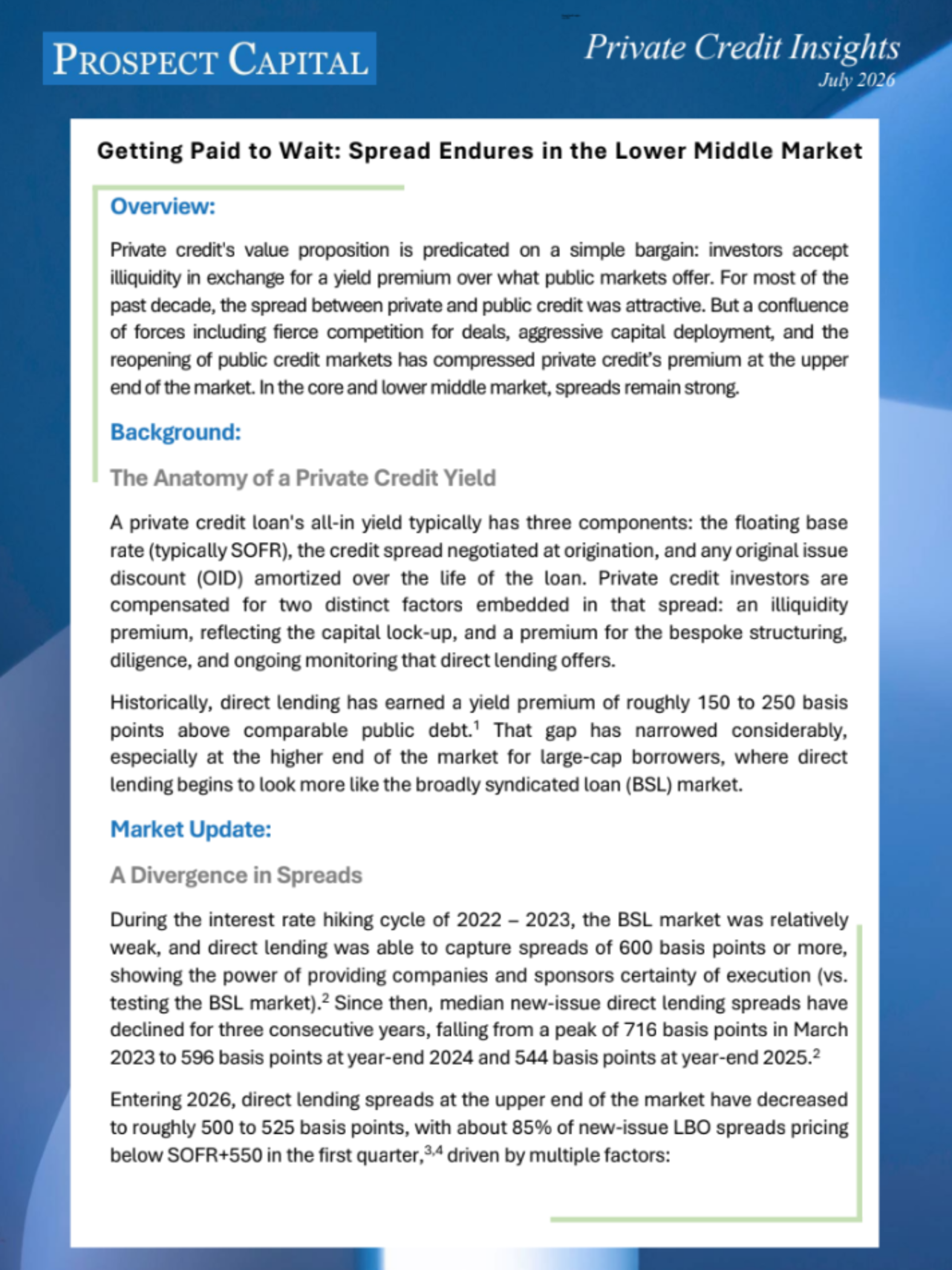
Private credit’s value proposition is predicated on a simple bargain: investors accept illiquidity in exchange for a yield premium over what public markets offer. For most of the past decade, the spread between private and public credit was attractive. But a confluence of forces including fierce competition for deals, aggressive capital deployment, and the reopening of public credit markets has compressed private credit’s premium at the upper end ofthe market. In the core and lower middle market, spreads remain strong.
Background:
The Anatomy of a Private Credit Yield
A private credit loan’s all-in yield typically has three components: the floating base rate (typically SOFR), the credit spread negotiated at origination, and any original issue discount (OID) amortized over the life of the loan. Private credit investors are compensated for two distinct factors embedded in that spread: an illiquidity premium, reflecting the capital lock-up, and a premium for the bespoke structuring, diligence, and ongoing monitoring that direct lending offers.
Historically, direct lending has earned a yield premium of roughly 150 to 250 basis points above comparable public debt.¹ That gap has narrowed considerably, especially at the higher end of the market for large-cap borrowers, where direct lending begins to look more like the broadly syndicated loan (BSL) market.
Market Update:
A Divergence in Spreads
During the interest rate hiking cycle of 2022 – 2023, the BSL market was relatively weak, and direct lending was able to capture spreads of 600 basis points or more, showing the power of providing companies and sponsors certainty of execution (vs. testing the BSL market).² Since then, median new-issue direct lending spreads have declined for three consecutive years, falling from a peak of 716 basis points in March 2023 to 596 basis points at year-end 2024 and 544 basis points at year-end 2025.²
Entering 2026, direct lending spreads at the upper end of the market have decreased to roughly 500 to 525 basis points, with about 85% of new-issue LBO spreads pricing below SOFR+550 in the first quarter,³⸴⁴ driven by multiple factors:
• Capital Raised: With so much capital raised in the direct lending universe (with the majority focused on the upper end of the market), supply of direct lending has caught up to, or exceeded, demand, which is driving more borrower-friendly pricing.
• BSL Market: The BSL market reopened in 2024 with the expectation of declining rates, which occurred with the first rate cut in September 2024 and continued into 2025. The BSL market became attractive to companies again with spreads declining from the 2022 peak of 450 – 475 basis points to 325 – 350 basis points at the start of 2026. Despite the recent market turmoil, the BSL market shows signs of picking up where it left off in 2025. Refinancing flows between the two markets reached near parity in 2025, with approximately $37 billion of BSL loans refinancing into direct lending and roughly $34 billion moving in the other direction, a clear break from prior years when flows ran largely one way.⁵
| THE BSL MARKET HAS HISTORICALLY BEEN THE LOWEST-COST OPTION FORBORROWERS; HOWEVER, WHEN MARKETS ARE IN TURMOIL AND CERTAINTYOF CLOSING BECOMES MORE IMPORTANT, BORROWERS TURN TO THE DIRECT LENDING MARKETS DESPITE THE COST PREMIUM. |
Where the Spread Premium Endures:
The Lower Middle Market: A Fragmented Borrower Universe
The U.S. middle market comprises approximately 200,000 companies.⁶ However, the attention of large-scale capital, from both BSL market participants and the growing cohort of upper private credit mega-funds, is concentrated on a narrow slice of that universe. Upper middle market companies, those generating $100 million or more in EBITDA, tend to attract financings from individual or multiple large lenders in “club” transactions, and their loan characteristics increasingly resemble the BSL market in terms of documentation standards and risk distribution.
Competition for the largest borrowers leaves the remainder of the middle market (the vast majority of companies by count) largely outside the reach of institutional capital at scale. The competitive dynamic specifically pits the upper middle market segment of private credit against broadly syndicated loans; lower middle market companies seldom enter this ring, and lower middle market direct lending does not contribute meaningfully to competition between public and private credit. The lower end of the market is left to direct lenders willing to do the work.
That work is considerable. To originate $1 billion in loans, a lender can do one $1 billion loan or twenty $50 million loans, essentially 20 times the work to loan the same amount of money. The operational burden of covering hundreds of smaller relationships, each requiring bespoke underwriting and active monitoring, creates a natural barrier to entry that limits the number of credible competitors. Privately held middle-market companies outnumber their privately held large-market counterparts by roughly 25 to 1, a fragmentation that rewards scale in origination rather than scale in check size.⁷
The result is a bifurcated lending landscape. At the top of the market, capital is abundant, terms are loose, and spread compression has eroded the premium investors once expected for illiquidity. Below that threshold, in the core and lower middle market, the opportunity set is large, lender competition remains limited, and structural protections are intact. For managers with the origination infrastructure to access it, fragmentation is not a liability. It is the moat that keeps the premium intact.
Maintenance covenants, which have been largely stripped from the larger end of the market due to fierce competition among lenders with significant amounts of capital to deploy, remain prevalent in core and lower middle market loans. While covenant-lite structures rose from 4% of direct lending deals to 21% of direct lending deals in 2025, this erosion was concentrated in larger transactions.⁸
The illiquidity premium is not disappearing; it is migrating. Spread availability is increasingly concentrated in the core and lower middle market, where competition from public credit is weakest, covenant protections remain strongest, and lenders retain pricing power that has eroded at the top of the market. For investors, the original bargain still holds: in the core and lower middle market, they are still getting paid to wait.
Sources
1. LSEG LPC and PineBridge Investments research; historical average yield premium of direct lending over broadly syndicated loans.
2. Kroll StepStone Private Credit Benchmarks; median new-issue direct lending spreads, global data, as cited in McKinsey & Company, Global Private Markets Report, 2026.
3. Lincoln International and PitchBook market data; upper middle market direct lending spreads, 2023–2025.
4. PitchBook, U.S. Credit Markets Quarterly Wrap, Q1 2026; share of new-issue direct lending LBO spreads priced below SOFR+550.
5. PitchBook | LCD; analysis of 2025 refinancing flows between the broadly syndicated loan and direct lending markets, as cited in McKinsey & Company, Global Private Markets Report, 2026.
6. National Center for the Middle Market, The Ohio State University Fisher College of Business, Middle Market Indicator.
7. Ares Management, “Why Is the U.S. ‘Middle Market’ Important?”; Capital IQ data as of January 2022.
8. PitchBook | LCD; covenant-lite share of direct lending transactions, as cited in McKinsey & Company, Global Private Markets Report, 2026.
Disclosures
Past performance is not indicative of future results.
Prospect Capital Management L.P. (“Prospect”) is an SEC registered investment adviser that was founded in 1988 (along with its predecessors). Prospect invests across the United States in diversified portfolios by industry, company, and situation, and its proprietary underwriting process and metrics have been developed over more than 30 years and through multiple economic cycles. Prospect has over 150 employees and $9.4 billion** of assets under management as of March 31, 2026. With a buy-and-hold mentality, Prospect’s objectives are to preserve capital by making credit and equity-focused investments at reasonable multiples of recurring cash flow, earn attractive current cash yields and long-term capital appreciation while achieving consistent low-volatility returns. For more information, call 212.448.0702 or visit prospectcap.com.
**The $9.4 billion of Assets Under Management (“AUM”) refers to the assets managed by Prospect and its affiliated registered investment advisors. AUM equals the sum of: (i) the gross assets of (a) Prospect Capital Corporation (“PSEC”), Priority Income Fund, Inc. (“PRIS”), Prospect Floating Rate and Alternative Income Fund, Inc. (“PFLOAT”), Prospect Credit REIT, LLC (“PCRED”), and Prospect Enhanced Yield Fund (“PENF”), and (b) pooled investment vehicles with respect to discrete assets for which Prospect has non-discretionary authority, (ii) any amounts available to be borrowed under certain credit facilities of the investment companies, (iii) total managed assets for real estate and structured credit investments, and (iv) uncalled capital commitments. Prospect’s AUM measure includes assets under management for which Prospect charges either nominal or zero fees. Prospect’s definition of AUM is not based on any definition of assets under management contained in any management agreements of the investment companies Prospect manages. Given the differences in the investment strategies and structures among other investment advisors, Prospect’s calculation of AUM may differ from the calculations employed by other investment managers and, as a result, this measure may not be directly comparable to similar measures presented by other investment managers. Prospect’s calculation also differs from the manner in which Prospect and its affiliates registered with the SEC report “Regulatory Assets Under Management” ($6.9 billion) on Form ADV.
This information is educational in nature and does not constitute an offer to sell or the solicitation of an offer to buy any securities. Prospect is not adopting, making a recommendation for or endorsing any investment strategy or particular security. All opinions are subject to change without notice, and you should always obtain current information and perform due diligence before participating in any investment. All investing is subject to risk, including the possible loss of principal. Prospect cannot guarantee that the information herein is accurate, complete or timely. We make no representation or warranty in respect of any information derived from the third-party sources which has not been independently verified. Prospect and its affiliates do not provide tax, legal or accounting advice. This material is not intended to provide, and should not be relied on for, tax, legal or accounting advice. You should consult your own tax, legal and accounting advisors before engaging in any transaction.