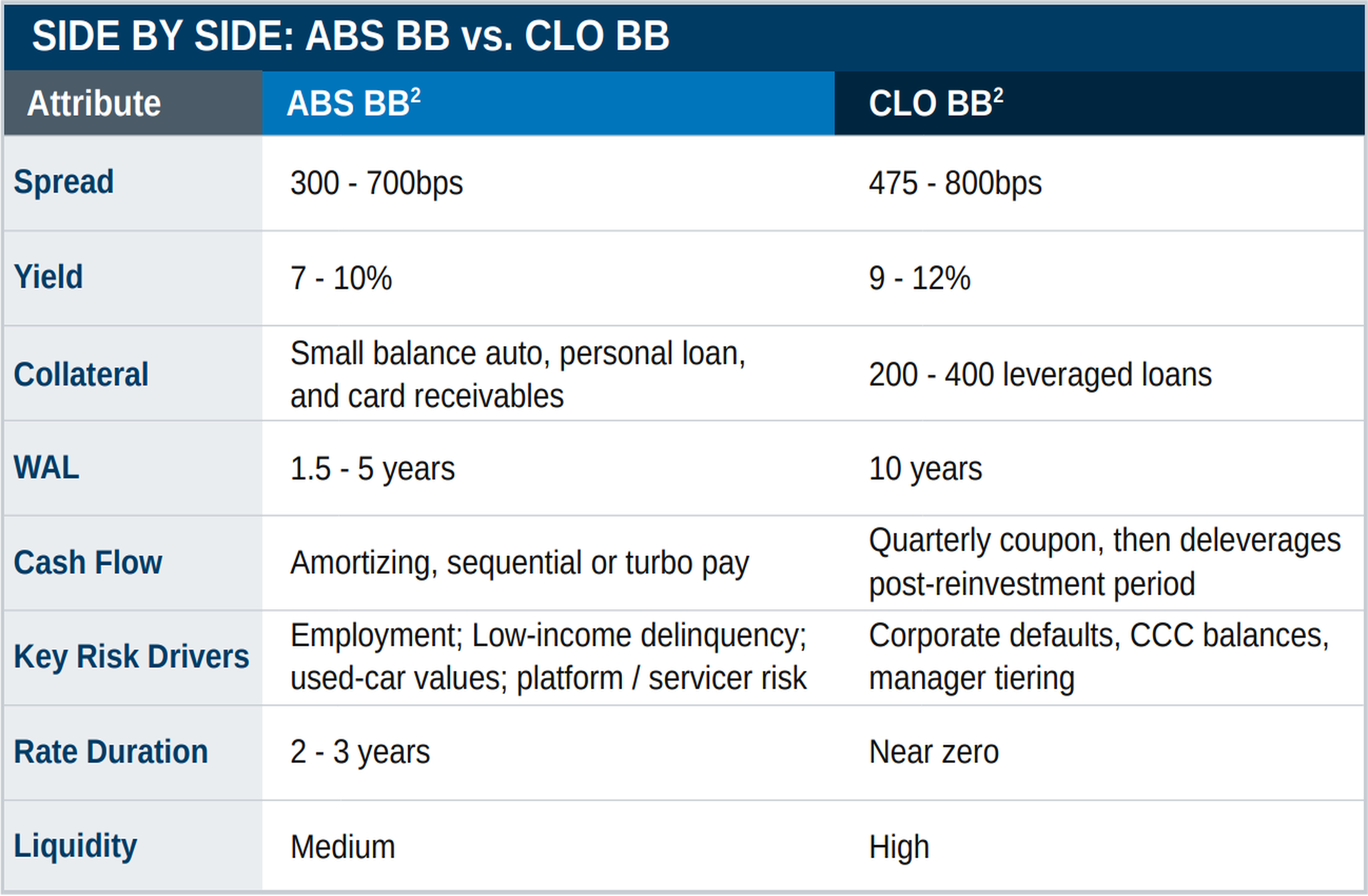
A CLO BB portfolio concentrates two risks: the U.S. leveraged loan default cycle and collateral manager skill. An allocation to BB-rated Asset Backed Securities (“ABS”) provides cash flows from sources beyond corporate loans.
We believe CLO BBs remain one of the best spread investments in structured credit, but we also believe a CLO BB portfolio can benefit from an ABS BB allocation. On its own, a CLO BB book concentrates two risks: the U.S. leveraged loan default cycle and collateral manager skill. ABS cash flows come from consumers, equipment leases, receivables, and other real assets with contractual cash flows, rather than leveraged corporate loans.
The non-real estate ABS market, at roughly $1.6 trillion¹, is a large and actively traded market with plenty of room for investors to deploy capital.
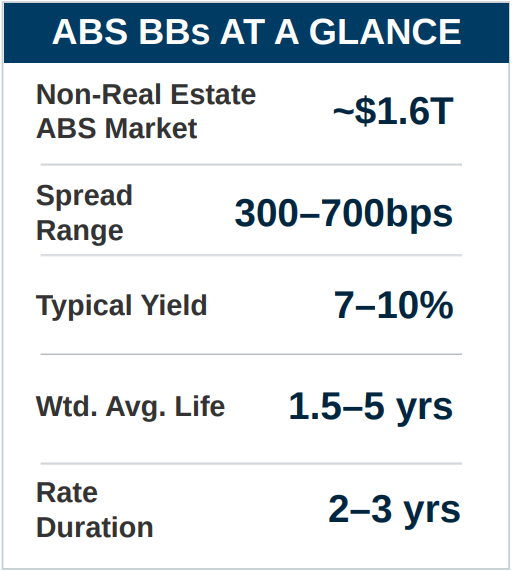
ABS paper generally trades tighter than CLO paper in the BB tranche, but it benefits from a shorter weighted average life (“WAL”), which can reduce mark to market risk, and, in most cases, minimizes exposure to any individual loan’s default.
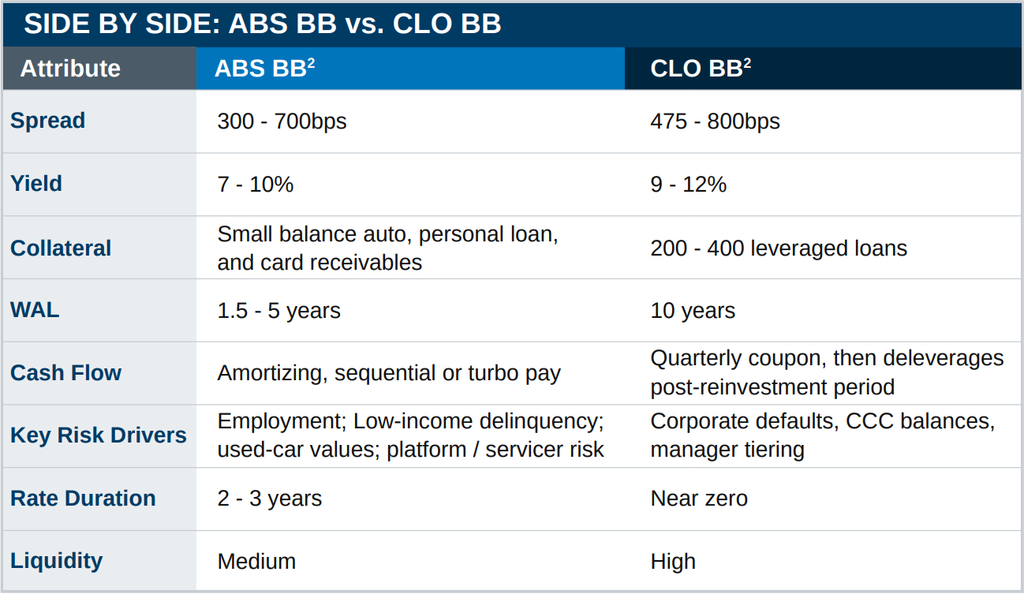
For illustrative purposes only. Based on analysis and views of Prospect Capital, unless otherwise noted.
Please see Important Disclosures & Endnotes for further information.
Where ABS Sits Inside ABF
Asset Backed Finance (“ABF”) refers to the broad universe of lending against contractual cash flows. Public ABS is its most liquid, rated, and actively traded tier. For yields that are comparable to CLO BB-rated paper, investors often focus on the following subsectors of the ABS market:
- Consumer (auto, unsecured, card)
- Commercial and equipment
- Esoteric and digital infrastructure (e.g., data centers, fiber, towers, whole-business, royalties)
Why the Two Fit Together
CLO BBs and ABS BBs sustain losses in different ways and at different points in the business cycle. A CLO is exposed to loan rating downgrades, manager decisions and trading style, and overcollateralization (“OC”) tests. ABS is exposed to household/ consumer finances, credit scores, and servicer execution. Those risks build at different points in the cycle and flow through different structural protections. A portfolio which has both CLO BB and ABS BB allocation works due to the following reasons:
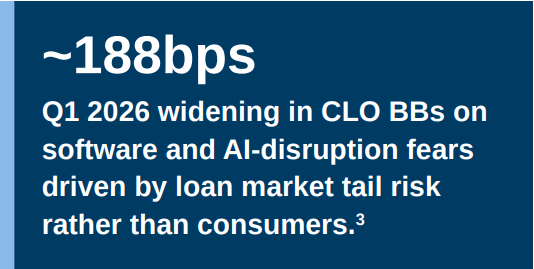
1. Different Default Drivers. CLO BB losses come from corporate defaults concentrated in levered corporate loans. Downgrades push loans into the CCC bucket and haircuts above the 7.5% CCC limit potentially erode par over time. ABS losses come from deteriorating consumer credit health, household employment and collateral values. The two cycles tend to overlap in a deep recession but diverge in sector shocks. Q1 2026 illustrated the point: software and AI-disruption fears pushed CLO BBs ~188 basis points wider³ , a move driven by loan market tail risk rather than consumers.
2. WAL. Amortizing ABS returns principal every month, unlike CLO BBs which have a longer expected life and pay quarterly. As referenced, the shorter ABS WAL can potentially reduce mark-to-market risk in a portfolio.
3. Rates. CLO BBs are comprised of floating-rate products with coupons that rise and fall with SOFR, i.e., income falls when SOFR falls and vice versa. Fixed-rate ABS is the opposite. A blend of securities reduces volatility of portfolio income across different macroeconomic cycles.
4. Diversifies Manager Concentration. A CLO BB book is concentrated on a set of collateral managers trading a similar loan universe. ABS risk sits with originators and servicers, a separate underwriting skill and a separate set of managers, diversifying beyond any individual collateral manager’s trading style and technique.
Summary
While there are inherent risks and drawbacks, we believe that CLO BBs are still the gold standard when it comes to yield per rating, and consumer ABS does not replace that. However, despite ABS BBs often trading tighter, in return, ABS paper can add monthly amortization, credit enhancement that builds as the pool pays down, fixed-rate coupons that hold up if rates fall, and credit exposure to household borrowers instead of leveraged corporate loans. Those benefits may show up when CLO BBs are under stress. When downgrades, OC test pressure, and manager tiering hit a CLO book, ABS can continue paying down principal, and that cash can be used to opportunistically acquire CLO investments. The portfolio potentially ends up with steadier cash flow, less severe losses in sector-specific selloffs, and cash available when CLO spreads are at their widest, allowing funds to take full advantage of market dislocations.
Important Disclosures & Endnotes
- Guggenheim Investments, “The ABCs of Asset-Backed Finance”, September 25, 2025.
- Intex, Pitchbook, Bloomberg Market Data, as of September 29, 2026.
- Palmer Square CLO BB Index, March 31, 2026.
Past Performance is Not Indicative of Future Results
Prospect Capital Management L.P.
Prospect is an SEC-registered investment adviser that, along with its predecessors and affiliates, has a more than 30-year history of investing in and managing high-yielding debt and equity investments using both private partnerships and publicly traded closed-end structures. Prospect and its affiliates employ a team of approximately 100 professionals who focus on credit-oriented investments yielding attractive current income. For more information, call 212.448.0702 or visit www.prospectcap.com.
This information is educational in nature and does not constitute an offer to sell or the solicitation of an offer to buy any securities. Prospect is not adopting, making a recommendation for, or endorsing any investment strategy or particular security. All opinions are subject to change without notice, and you should always obtain current information and perform due diligence before participating in any investment. All investing is subject to risk, including the possible loss of principal. Prospect cannot guarantee that the information herein is accurate, complete or timely. We make no representation or warranty in respect of any information derived from the third-party sources which has not been independently verified.